Reading Health in Dou Shu: Which Medical Insurance to Buy
AI translated from the original Chinese.
Generated by Gemini
Life is long and any illness can happen, but that doesn't make reading illness in Dou Shu meaningless. Every body has its weakest part, linked to heredity, genes and even environment. So I often tell clients: "Read your health in Dou Shu, see where you are weakest, and buy medical insurance for that; it may help in the future."
Traditional Chinese medicine holds that each organ of the body has its Five Elements attribute, and the stars of Dou Shu have Five Elements attributes as well, so in theory one can see the body's weak points. According to my teacher, Master 紫雲 (Zi Yun) even obtained a Chinese medicine license in order to study the connection between Dou Shu and Chinese medicine. Master 紫雲 has published a great many classic works on Dou Shu, and the one he is proudest of is 《斗數論疾病》 (Dou Shu on Illness).
That book raised the reading of health in Dou Shu to a new level. When we discuss illness according to Master 紫雲's theory, it matches real cases, and after years of verification it is quite credible. But I must stress: if you are ill, see a doctor, not a Dou Shu teacher. We readers can only point out the body's weakest point; we have no power to cure illness. Readers must take this to heart.
Some may ask: "Can Dou Shu really detect any illness?" The answer is yes, but not entirely. Why? Traditionally each body part has a Five Elements attribute, and a reader can indeed find "the weaker element in the body and its corresponding organs." But modern medicine has advanced and illnesses are many and varied. For example, if we see that the "Metal" organs are weaker, illness would correspond to Metal organs, including the respiratory system, skin, large intestine and so on; for a reader to pinpoint exactly which Metal illness it is, is difficult. So advice must still be given according to the subject's actual situation.
Today let's discuss illness through a case. The chart is as follows:
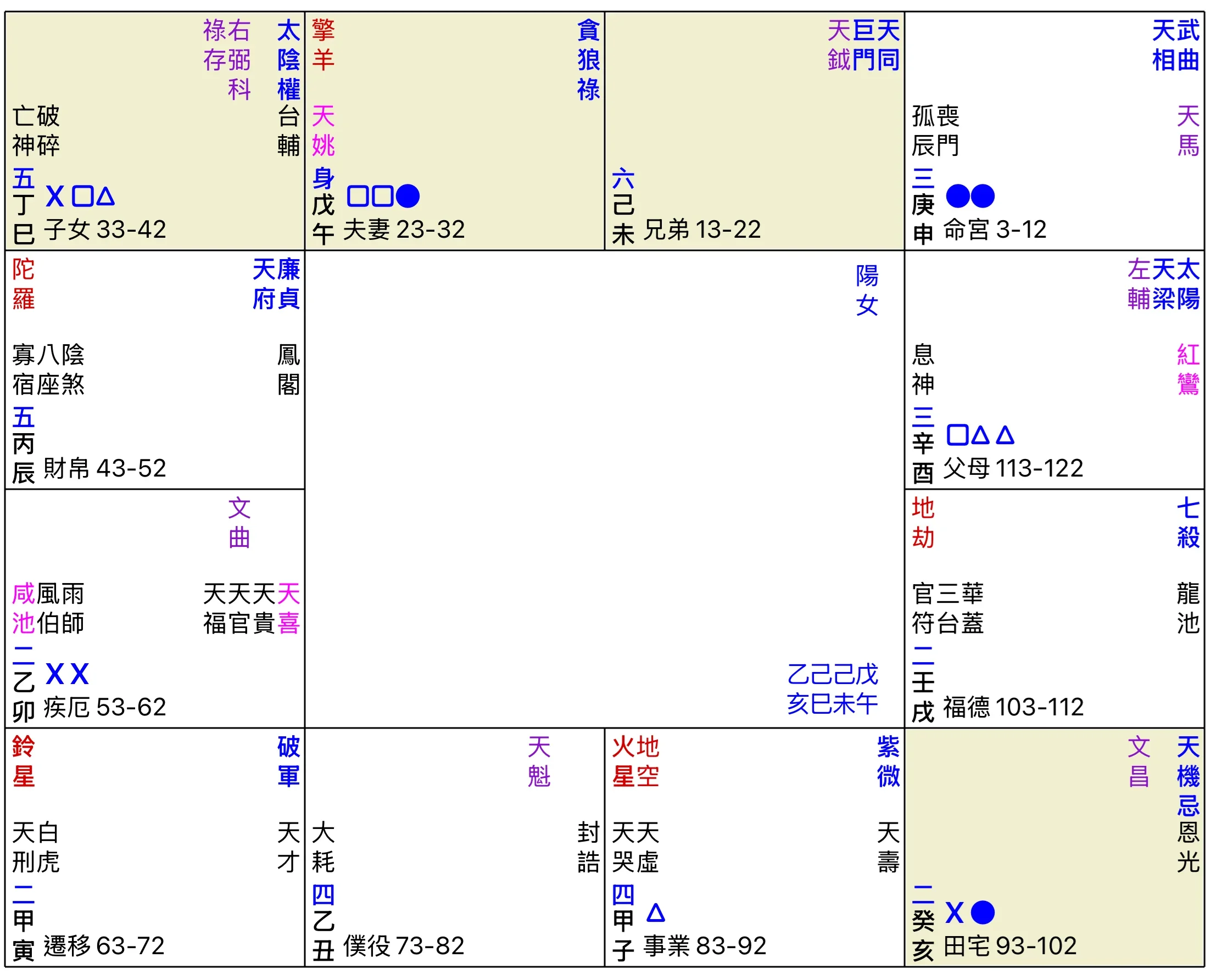
From this chart we can see that the 亥 Palace, together with its 三方四正 (three sides and four directions), is where the 化忌 (Ji) concentrate.
- 癸亥: 1 化忌
- 己未: 0 化忌
- 乙卯: 2 化忌
- 丁巳: 1 化忌
A chart has at most 4 化忌, and this subject has all 4 concentrated on 癸亥, which shows that the stars of 癸亥 are mostly in trouble.
Next, anyone with a basic grasp of Dou Shu should know that "破軍 (Po Jun) is the lord of illness," so the Ji stars transformed from 破軍's heavenly stem, and from the stem of 破軍's 疾厄宮 (Health Palace), greatly affect illness. That is:
- 破軍's stem 甲: 太陽 (Tai Yang) becomes 化忌
- the stem of 破軍's Health Palace, 辛: 文昌 (Wen Chang) becomes 化忌
太陽 化忌 does not affect the 亥 Palace, but 文昌 化忌 puts yet another 化忌 in 亥, and this one is tied to 破軍, so it must not be taken lightly. The main star of the 亥 Palace is 天機 (Tian Ji). Which parts of the body does 天機 represent?
- 天機, Wood: liver, gallbladder, blood, hands, eyes, uterus, breasts, penis, and so on.
At this point we must give suitable advice according to the subject's actual circumstances. So what went wrong in this chart?
- At age 24 (East Asian reckoning), the subject developed leukemia, and after long hospitalization and chemotherapy, finally beat it.
Most bodies have weak points. If a reading can reveal one's health so one can take care of it, keep an eye on it over the long term, and back it with suitable medical insurance, it may be of real benefit. But once again: when your body has a problem, see a doctor, not a fortune teller.