The Marriages of Charles III
AI translated from the original Chinese.
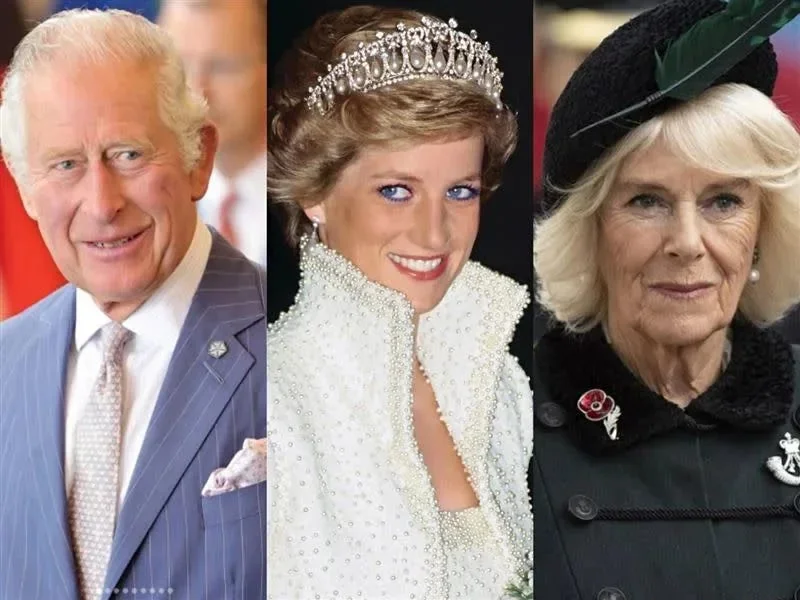
From the news report "The Queen is Camilla, not Diana: the British public, saddened and resigned, can only accept it"
Last time we discussed the Queen's case of growing old together; today let's also discuss the marriages of Charles III.
The British royal family has always been the focus of media attention, and the current king's love life has often been put under the microscope. Compared with his mother Elizabeth II's conservative traditions, Charles III seems more his own man in marriage. Today let's talk about his relationships with Princess Diana and Queen Camilla!
Case Summary
Charles III: born 21:14, November 14, 1948, in London.
Princess Diana: born 1961
Queen Camilla: born 1947
Since we're only discussing love, a brief note on the three people's relationships is enough.
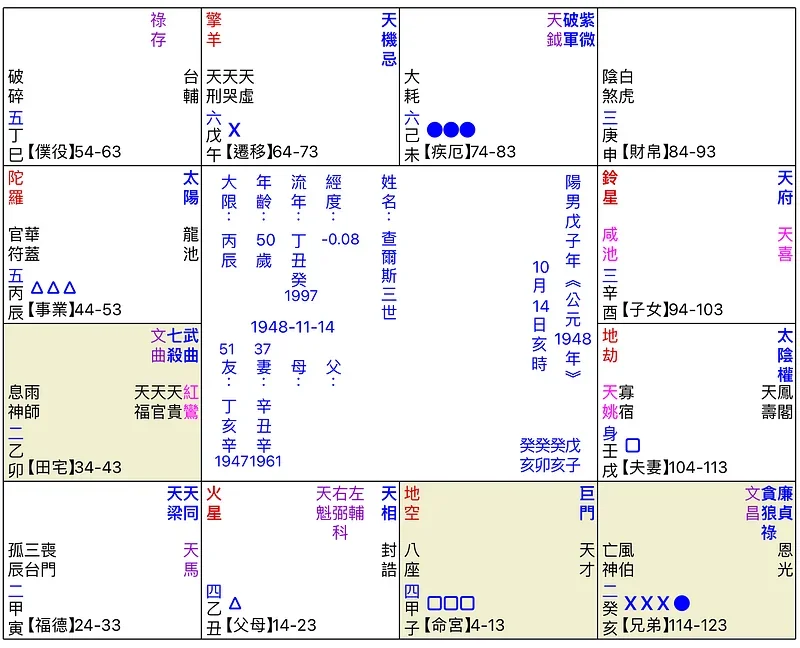
For matters of love, let's make some transformations.
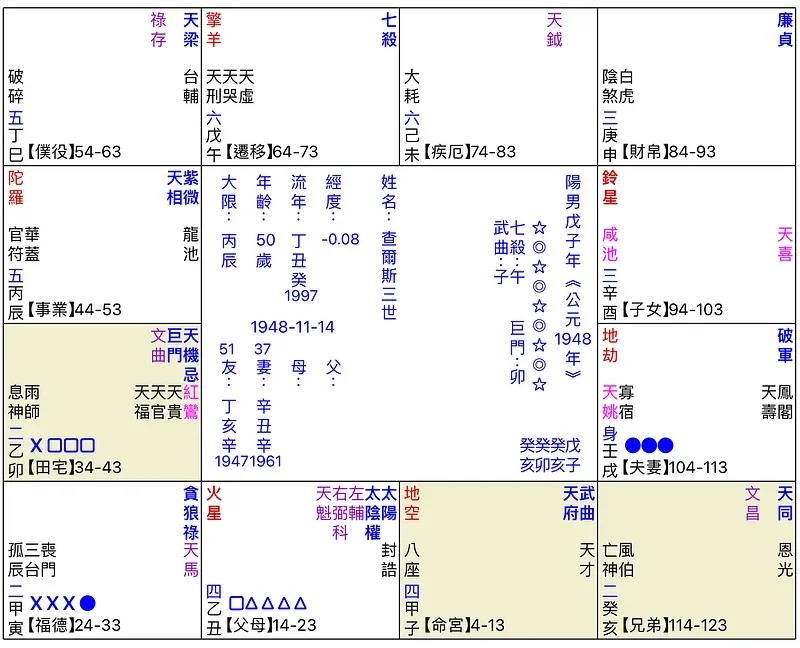
The star of marriage: how 紅鸞 (Hong Luan) shows up
紅鸞 has 3 化權 concentrated: a certain stubbornness about a spouse, less able to follow the traditional institution of marriage.
How Princess Diana shows up in Charles III's chart
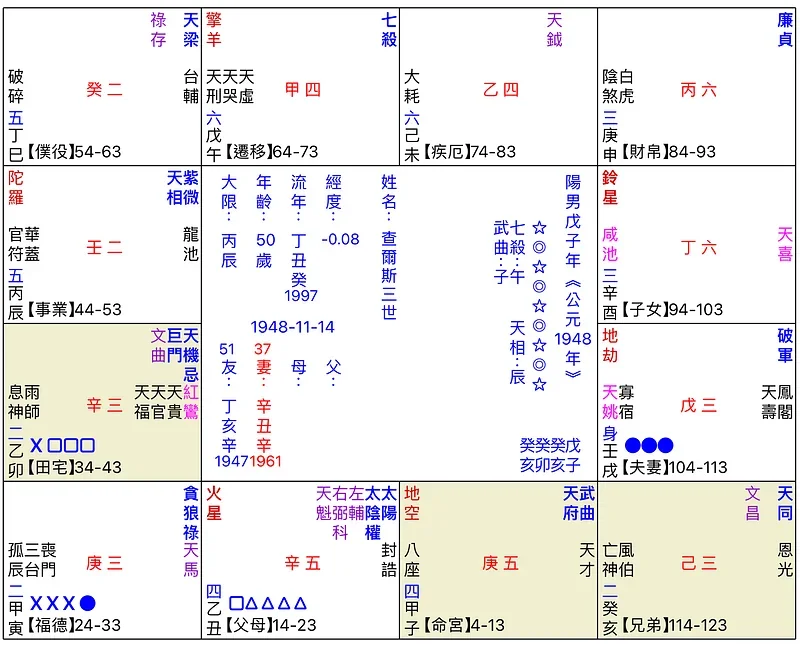
Marking Princess Diana's stems on the chart
In the palace of 紅鸞, Princess Diana's stem is 辛. 巨門 (Ju Men) becoming 化祿 is naturally an image of marriage, but 文昌 (Wen Chang) becomes 化忌. 昌曲 (Chang Qu) belong to documents, and in marriage, 昌曲 化忌 can stand for the marriage certificate. Under 文昌 化忌, the possibility of going separate ways was planted from the very beginning.
How Queen Camilla shows up in Charles III's chart
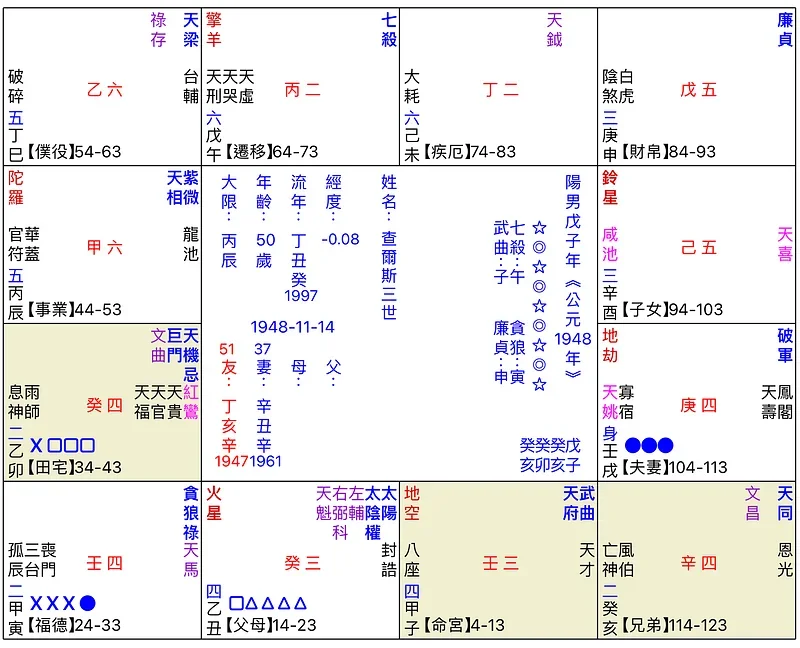
Marking Queen Camilla's stems on the chart
In Charles III's 紅鸞 palace, Queen Camilla's stem is 癸, making 巨門 become 化權; 貪狼 (Tan Lang) becoming 化忌 has little effect on the 卯 Palace.
Overall Judgment
Princess Diana makes 巨門 become 化祿, an image of marriage, but 文昌 becomes 化忌, so after marriage their outlooks easily clash, with disagreements and arguments over all sorts of small things.
Queen Camilla makes 巨門 become 化權, but no 化忌 negatively affects Charles III's 紅鸞, so their outlooks are more in tune and they can better support each other.
Strictly speaking, though, neither woman does great damage to Charles III's 紅鸞, so even though he divorced, he was married to both in the end.
Today we've simply looked at marriage through the workings of 紅鸞. As for the details of the three people's romantic entanglements, readers can study their main stars.
Love itself needs no outsider's comment, and there's nothing wrong with pursuing happiness. When a marriage runs aground, parting amicably is a good thing.