Opening a Restaurant: The Expected Returns of a Business
AI translated from the original Chinese.
What is "destiny" (命運)? It actually means "pattern" (命格) and "fortune" (運勢). There's much to say about the pattern, and "talent" is one part of it; "fortune" is the good or ill that the pattern gradually triggers as time runs on. In short, the pattern is like a bomb, and fortune is the spark. Only when the spark ignites the pattern does the pattern take effect. If it is never ignited in a lifetime, then even with the pattern, it can't fully show. Many clients have probably heard me say that I once saw someone with an excellent pattern who is now advanced in years, without a satisfying career, working as a cleaner in a department store to make ends meet. That's an example of a pattern that fortune never ignited.
Some clients have said I'm good at guessing occupations from charts. But really I'm just guessing the most likely line of work from the talents the chart shows, and I'm right maybe sixty or seventy percent of the time. After all, there are thousands of occupations and many people born at the same time; how could everyone born at the same time do the same job? The clients I dread most treat fortune telling as channeling: they sit down, say nothing, and expect me to see through everything. If I could channel spirits, why would I spend twenty years studying Dou Shu? Ha. Fortune telling is fortune telling, channeling is channeling. Fortune telling "infers" life's fortunes and misfortunes from the birth data; the key is "inference." Channeling, I think, is a higher state than fortune telling. If I could channel, why would I need to "calculate" fate?
For me, Zi Wei Dou Shu is like a mathematical function: put in some data and out comes a result. Master 紫雲 (Zi Yun) stresses that fortune telling also follows the diagnostic principles of Chinese medicine: looking, listening, asking and feeling.
- Looking: first observe the client's appearance and the life qualities they show.
- Listening: hear the client describe the problem.
- Asking: based on the problem, ask for relevant information.
- Feeling: bring the relevant information into Zi Wei Dou Shu and describe the outcome of the matter asked about.
That is, fortune telling must adjust the angle from which the chart is read according to reality. Reading one chart start to finish without adjusting for the facts makes fortune telling meaningless.
Enough preamble; let's get to the point!
A friend said that years ago I read her brother's chart and said: "Your brother might sell food, but he shouldn't. He won't lose money, but he won't make any either. Don't waste the effort." I had long forgotten that reading, but this year her brother really is preparing to open a restaurant, so my friend told me how my prediction had turned out.
When I heard this, I pulled up the brother's chart. Indeed, in 2021, the 辛丑 year, he has a strong desire to open a restaurant. I asked: "Does your brother want to sell fast food? But he probably won't handle the cooking; his work will mainly be front-of-house, serving, and when needed, the cash register." My friend asked her brother whether that was right:
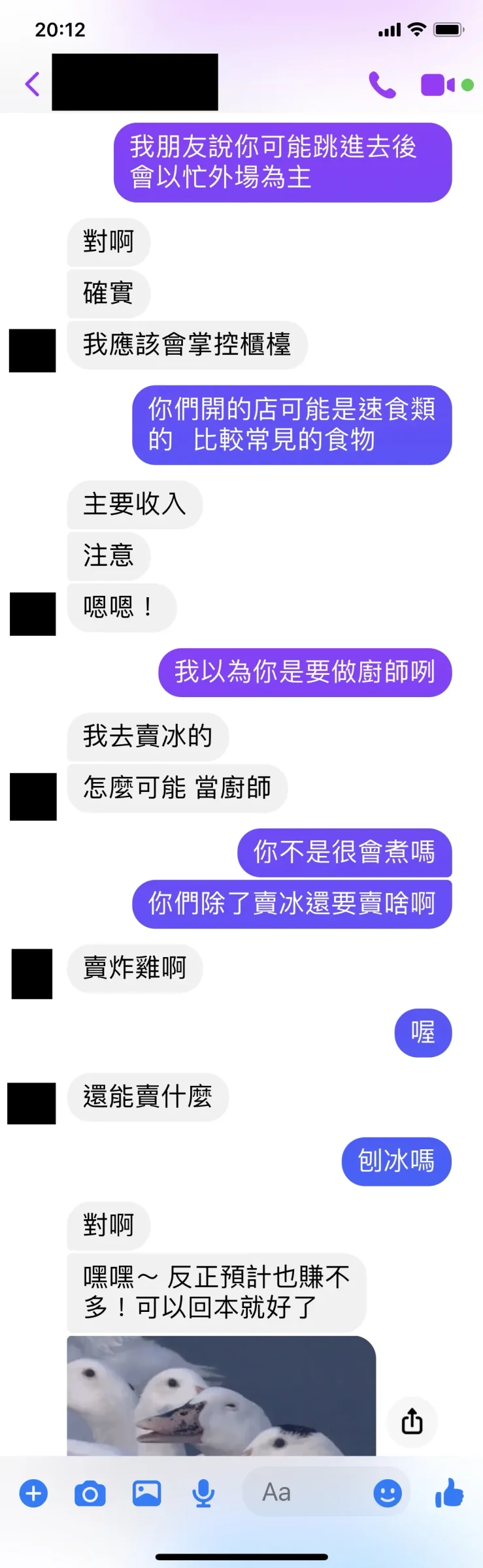
I got the "fast food" but didn't see the "shaved ice." I need to reflect on that.
Back to the beginning: how does the brother's chart show he wants to open a restaurant and sell fast food?
The original chart:
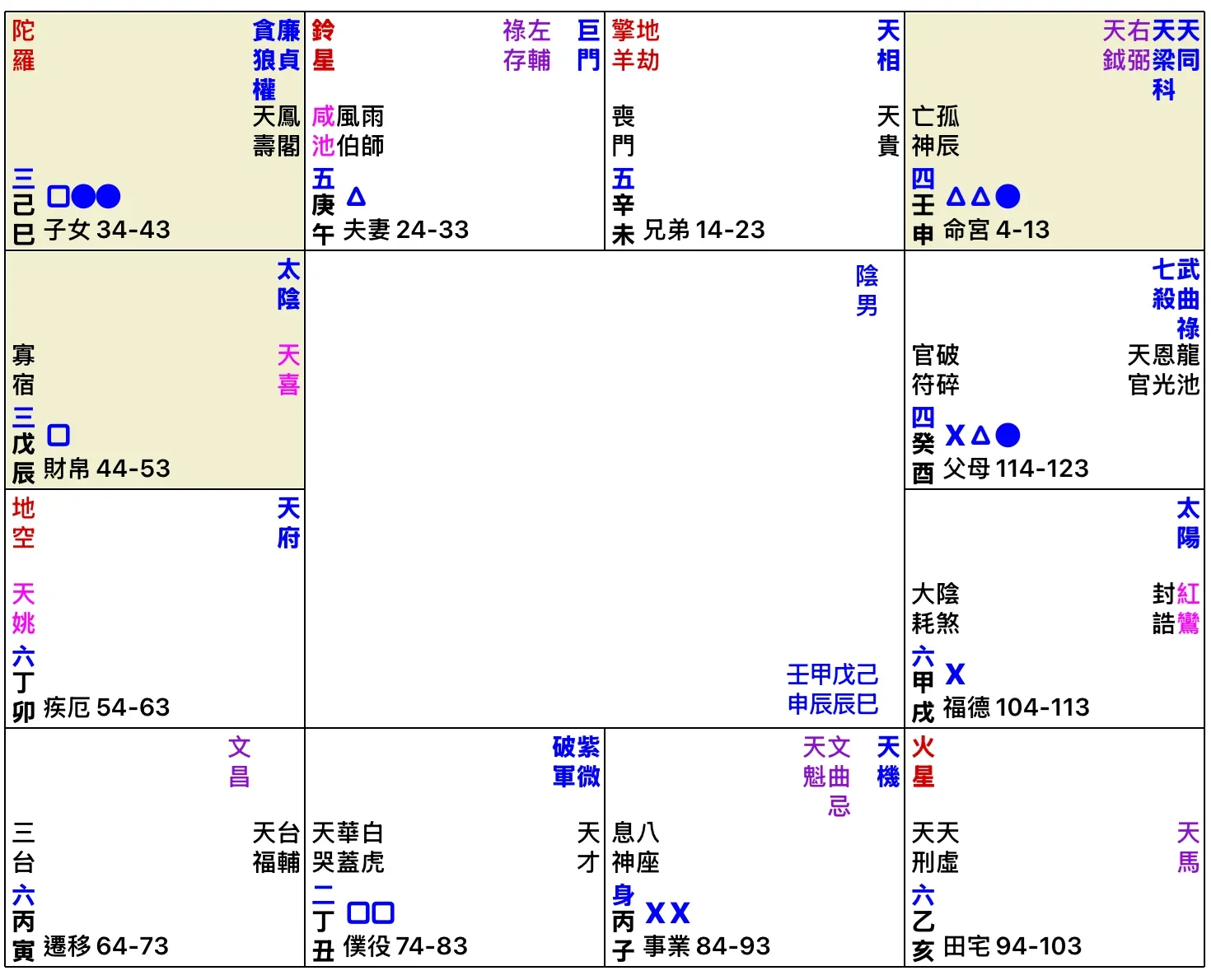
As usual, this chart doesn't say much. Skipping why I predicted years ago that he'd open a restaurant, let's lock onto 2021, the 辛丑 year, bring in that year's data, and see why he'd want to open a fast food restaurant in 2021:
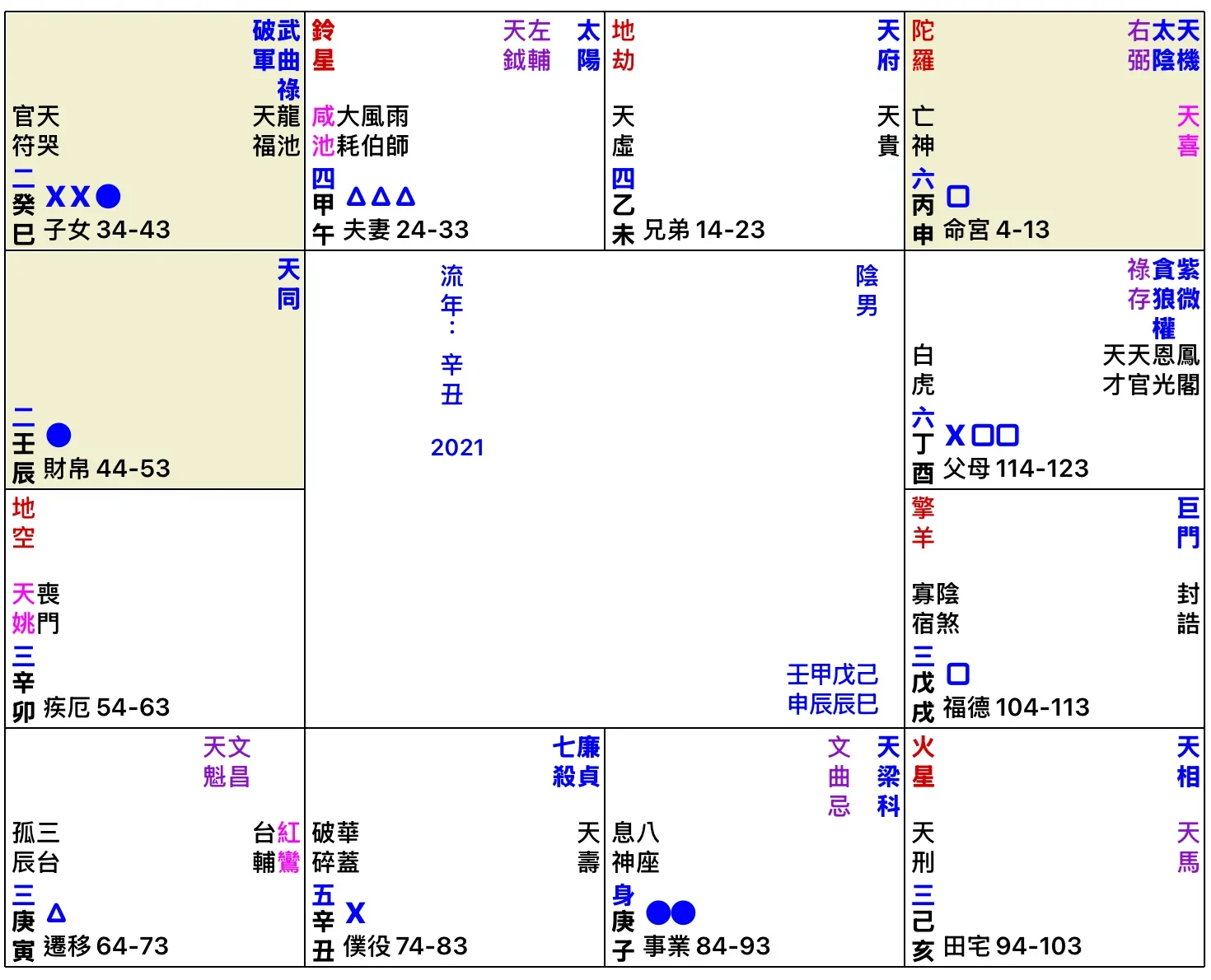
Where is the sign of starting a business?
From the chart above, we can clearly see 化權 (□) concentrated in the 酉 Palace. Generally, concentrated 化權 can mean promotion or starting a business.
The brother works at a big company, but in reality there's no sign of promotion, so we don't talk about promotion; we talk about starting a business.
Of all the trades, why choose a restaurant?
天相 (Tian Xiang) governs clothing and food, so we bring in 天相's data:
- 天相, stem 己: 武曲 (Wu Qu) becomes 化祿, 貪狼 (Tan Lang) becomes 化權.
The 酉 Palace is already where 化權 concentrate, and 天相 adds another 化權 to it, so in starting a business he easily chooses to sell clothing or food.
Why front-of-house and the cash register?
化權 concentrate in 酉, and 天相's Quan also enters 酉, but 天相 is not a star in the 酉 Palace, so he makes money through "clothing and food" without cooking himself.
The 酉 Palace:
- 貪狼: governs action and adaptability; runs the front of house
- 紫微 (Zi Wei): holds authority; can run the counter and has certain powers
- 祿存 (Lu Cun): money itself; handles the cash register
How do we know it's a fast food restaurant?
The restaurant is read mainly through 天相
- 天相 in 亥 shows the following (with its three sides and four directions: 未, 卯, 巳)
- 天馬 (Tian Ma): customers coming and going, even delivery.
- 火星 (Huo Xing): if 天相 governs food, 火星 naturally stands for the heat of cooking. 火星 is high heat and fast: food comes out quickly.
- 天相 seeing 空劫 (Kong Jie): 地空 (Di Kong) in 卯 and 地劫 (Di Jie) in 未; 空劫 also mean speed and a high frequency of orders.
Overall judgment: customers come and go fast, food comes out fast, high heat. As far as I know, only fast food fits this image.
As for "shaved ice," honestly, I really can't see where the image of shaved ice is. For now I can only guess that once the restaurant is running, it will gradually focus on fast food, and shaved ice won't be the main seller. To be verified.
Why is the income only ordinary?
Quan stars concentrate in 酉, but so do Ji stars, and the Lu stars are too weak, so there's probably no big money. The worst case is hard, busy work with ordinary returns, in which case he'd be better off working for another company or restaurant.
Everyone has something they're set on. I remember once asking my teacher: "Has any client, after learning their future fortune was poor, chosen to avoid it and so changed their destiny?" My teacher said nothing, only smiled and shook his head.
I think people sometimes have a thought that they "must do something." Why must they? They can't say, but they simply must. I often call this the push of fortune.
But I think everyone has the right to try. Even if a chart shows that doing something isn't favorable, doing it, even failing, still counts as gaining experience, which may nourish future success. If you see a chart saying something isn't favorable and so don't do it, avoiding the bumps ahead, might that lower your chances of future success? All I can say is that I'm no immortal and can't channel spirits; I really don't know. What I have finally learned in studying fate is: go with the flow!