The "Natal Chart" and the "Variant Chart" in Zi Wei Dou Shu
AI translated from the original Chinese.
Since Master 紫雲 (Zi Yun) began publishing books on Dou Shu, the field has gradually moved beyond the traditional view. Through the continued in-depth research of Master Zi Yun and his students, Zi Wei Dou Shu is no longer "your Life Palace is like this, so your personality will be like this; your Career Palace is like this, so your work will be like this!" A person's good and bad fortunes over a lifetime can't be read from the traditional "palaces"; instead you have to start from the "patterns"! Theory on paper alone convinces no one, so let's use a real case to discuss what the "patterns" of Zi Wei Dou Shu are and how they affect a person's life!
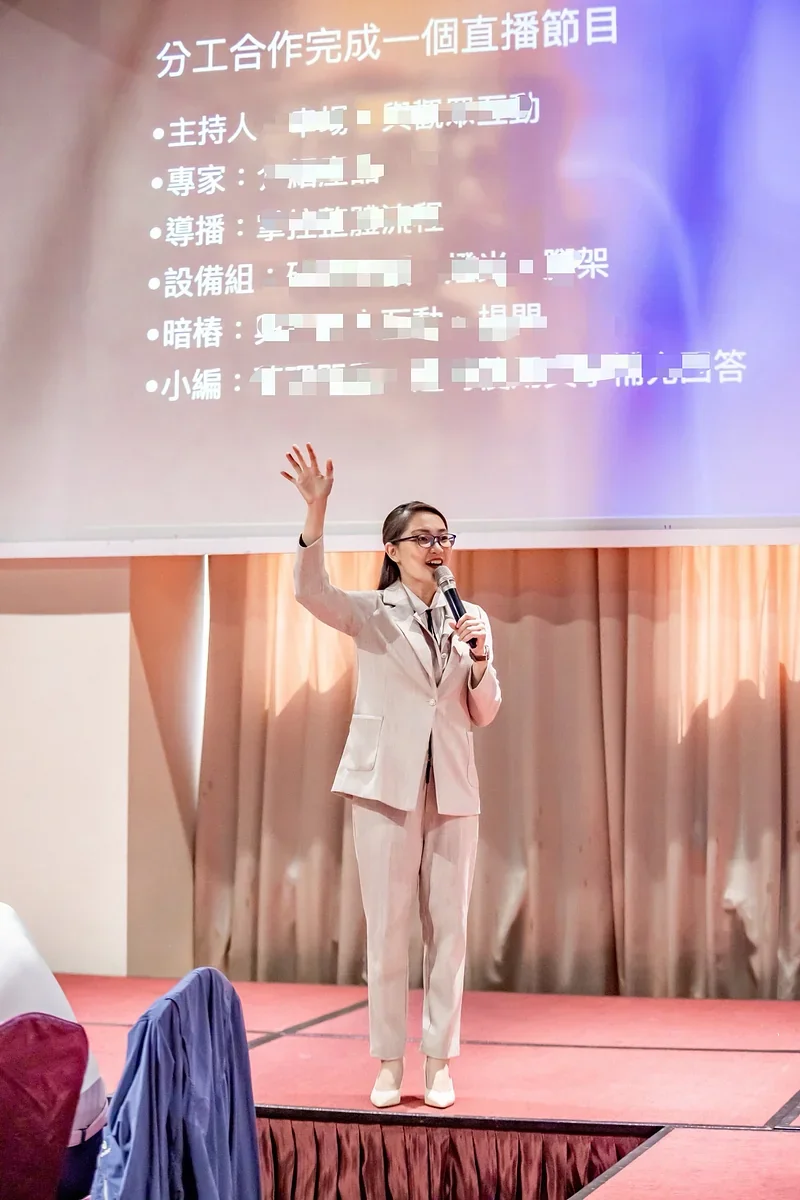
Take Ms. Hsu as an example: from wedding emcee to professional lecturer and company owner. Can the natal chart explain all this?
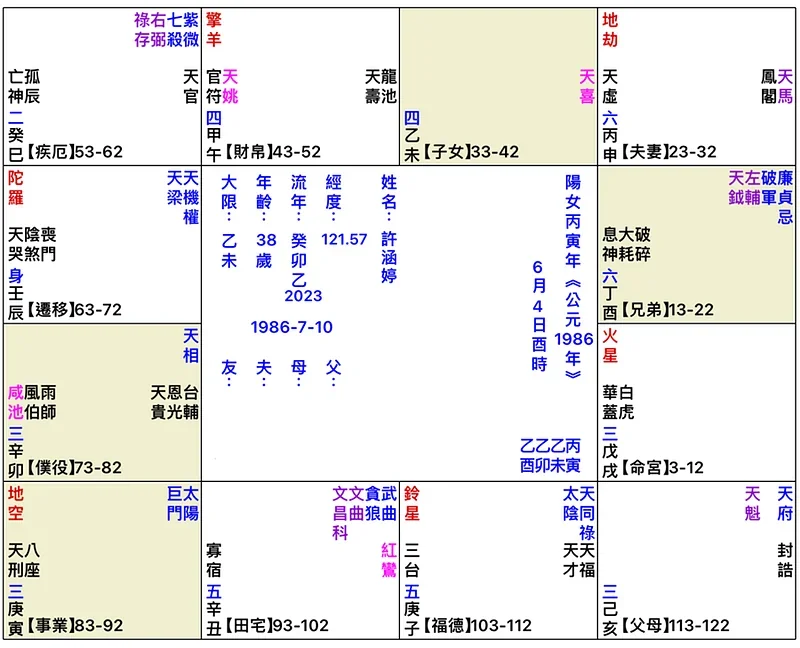
The traditional view
Structure of the Life Palace
- The Life Palace is empty, so it borrows 天機 (Tian Ji) and 天梁 (Tian Liang) from the 辰 Palace
- 火星 (Huo Xing) sits there
- 地空 (Di Kong), 陀羅 (Tuo Luo) and 擎羊 (Qing Yang) meet from the three sides and four directions
- The Travel Palace sees 化權 meeting
Analysis of the Life Palace
- The old books say: "天機 and 天梁 make a clerk." A "clerk" means a civil servant; even if not a civil servant, an ordinary office worker
- The old books say: "天機 and 天梁 meeting 擎羊: harm and conflict early, loneliness late." That is, a pattern of harm and conflict from childhood, a poor relationship with family, even no contact at all
- 火星, 擎羊 and 陀羅 all affect Ms. Hsu's personality: as the names suggest, a bad temper, impatience, standoffishness, no friends. Especially seeing 化權, all the more self-righteous
Structure of the Career Palace
- 太陽 (Tai Yang) and 巨門 (Ju Men) in the Career Palace form the 巨日 pattern
- 地空 sits in the Career Palace
- The three sides and four directions see 地空, 地劫 (Di Jie), 擎羊 and 火星
Analysis of the Career Palace
- The old books say: "巨門 and 太陽 guarding the Life Palace in 寅, without 劫空 and the four malefics, enjoy salary and fame." This person's Career Palace happens to see exactly 劫空 and the four malefics, so naturally she can't "enjoy salary and fame"
- The old books have sayings like "火陰, the Ten Evils pattern" and "太陰 (Tai Yin) with 擎羊: people leave, money scatters." 太陰 and 太陽 are paired stars and can be swapped. This person's 巨日 pattern instead becomes "Ten Evils" and "people leave, money scatters," which is also bad
Conclusion
This person has a poor relationship with family, will take civil service as her main direction in life, and is eccentric and bad-tempered. But is that really so?
The facts
Ms. Hsu's profile is at https://portaly.cc/HanTing. Her experience is complete and impressive; she also heads a company, and her career is doing quite well. It seems not to fit the chart analysis above.
The variant-chart view
First, we must move beyond the traditional view of the chart, that is, stop staring at the "Life Palace" and "Career Palace" to judge a person. Instead, start from the variant chart and the pattern as a whole.
Traditional Zi Wei Dou Shu uses only the birth year's Lu, Quan, Ke and Ji, but in fact the year, month, day and hour of birth all have Lu, Quan, Ke and Ji.
- 化祿 symbol: ●
- 化權 symbol: □
- 化科 symbol: △
- 化忌 symbol: ╳
Let's see what Ms. Hsu's variant chart shows:
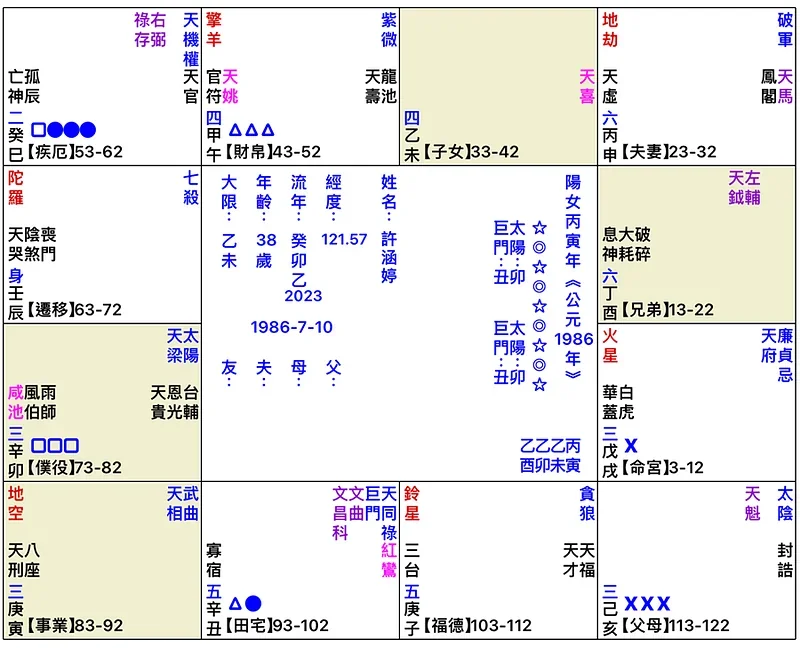
Structure of 化祿
- 化祿 concentrate in 丑 and 巳
- The 丑 Palace holds 文昌 (Wen Chang) and 文曲 (Wen Qu)
- The 巳 Palace holds 右弼 (You Bi) and 祿存 (Lu Cun)
- From the three sides and four directions, 左輔 (Zuo Fu) and 天鉞 (Tian Yue) meet from the 酉 Palace
- The 丑 Palace also sees the romance stars 紅鸞 (Hong Luan) and 天喜 (Tian Xi)
Analysis of 化祿
- This person's Lu stars center on 丑 and 巳; that is, she very likely takes the 丑 and 巳 palaces as the focus of her work
- 天同 (Tian Tong), 巨門 and 天機 are all stars of harmony; without malefics, her work centers on cooperating with others
- 文昌 and 文曲: this person very likely makes a living from "writing" and "speaking"
- 天鉞 is the teacher; this person very likely does teaching work
- 紅鸞 and 天喜 are marriage; working in the wedding industry is good
- 祿存: working in this industry, she can gain security and recognition in her career
Structure of 化權 and 化忌
- 化權 concentrate in the 卯 Palace; 化忌 concentrate in the 亥 Palace
- The 卯 Palace holds 太陽, 天梁 and 咸池 (Xian Chi)
- The 亥 Palace holds 太陰 and 天魁 (Tian Kui)
- For the 卯 Palace: it sees 天魁, 天鉞 and 左輔
- For the 亥 Palace: it sees 天魁, 右弼 and 祿存
Analysis of 化權 and 化忌
- This person's Quan stars center on 卯, and the 卯 Palace is also where her personality traits mainly come into play
- Quan stars concentrated in 卯: 化權 speaks of "promotion" or "starting a business"
- 太陽 and 天梁 in 卯: warm, caring for all, sustained in her work, not starting strong and fizzling out (太陽 in the palaces from 未 to 丑 would show work that starts strong and fizzles out)
- 咸池: charisma
- 天魁 and 天鉞 likewise speak of being a teacher
- 左輔 gives her work variety
- 化忌 concentrate in 亥, but 太陰 likes the night; in the 亥 Palace it has positive power, and it sees no malefics. At most it speaks of hard work and days and nights reversed, not to be read negatively
Structure of 化科
- 化科 concentrate in the 午 Palace
- The 午 Palace holds 紫微 (Zi Wei) and 擎羊
- For the 午 Palace, it is the 紫府廉武相 (Zi Wei, Tian Fu, Lian Zhen, Wu Qu, Tian Xiang) star group
- It sees 擎羊, 火星, 鈴星 (Ling Xing) and 地空
Analysis of 化科
- This person's Ke stars center on 午; 化科 governs a person's learning ability, talent and reputation
- 紫微 化科 in 午 sees 擎羊. 紫微 is the emperor star; 化權 alone isn't special, since an emperor has power to begin with. 化科 is what makes it special: besides having power, she loves to learn
- 擎羊 sits with 紫微 in 午; because of 化科, the malefic is tamed and put to use. This person acts immediately: once she decides what to do or learn, she moves at once
- Standing in the 午 Palace, it sees 貪狼 (Tan Lang), 火星 and 鈴星, forming the 火貪格 and 鈴貪格, sudden-fortune patterns. She has tremendous drive for learning
- 紫微 in 午 is influenced by 地空 in the 寅 Palace, which mainly dilutes the negative effects of 擎羊 and 火星, removing this 紫微's harshness and making it more approachable
The facts
Ms. Hsu's way of working and personality are plain to anyone who knows her well, and together with her profile, wedding emcee, lecturer, owner, consultant, all fit her chart's pattern.
Conclusion
Can the traditional way of reading Zi Wei Dou Shu really go everywhere without question? I believe Ms. Hsu's chart analysis makes it clear.
In fact, fate itself is endlessly changeable. With just one natal chart, some situations can indeed be explained, but the great majority are set-in-stone charts, plausible but wrong, unable to get to the point.
Every "numerological art" involves "change." King Wen's hexagram divination has the "original hexagram" and the "changed hexagram," and the Zi Wei Dou Shu chart naturally distinguishes the "natal chart" from the "variant chart." But in the long river of history, as time passed and masters held back a trick with each generation they taught, it was altered beyond recognition. Only with 斗數論兄弟 (Dou Shu on Siblings) did Master Zi Yun begin to publish his "別觀法" (alternate viewing method) and the method of "variant charts."
The alternate viewing method is not made up at random. In the Qing dynasty there was a specialized Dou Shu book called 紫微星訣 (Secrets of the Zi Wei Stars), and this old text already named the alternate viewing method, meaning the Four Pillars of birth also have their use in Dou Shu.
The variant chart method was already used in Zi Wei Dou Shu in the past, though when it began isn't known. At least as early as the 1980s, Master Zi Yun was using it, but he didn't publish it for a long time.
Zi Wei Dou Shu hides its secrets too deeply; with one natal chart, it's hard to explain why. Ms. Hsu's case happens to explain the essentials of the variant chart.