Opening a Restaurant, Again: Western Desserts
AI translated from the original Chinese.
Many fellow Dou Shu enthusiasts come to ask questions after reading my articles, which I think is a good thing. If you have questions about Dou Shu, feel free to message my Facebook fan page; I reply when I have time. For me, Dou Shu is a discipline to be approached rigorously, so asking questions and learning from each other through discussion is a fine thing.
My teacher often says the best way to study Dou Shu is to collect cases, tag them, and search by tag. Gathering a large number of cases of the same type, you can discover patterns. He is right. So during consultations I type notes on the spot, check whether what I see matches what the client says, and record the reading as fully as I can. After recording, I organize the notes. Honestly, the work is tedious, but what self-improvement isn't hard work?
I now have many "opening a restaurant" cases, from street stalls up to a Michelin one-star restaurant. Laying these cases out one by one, I can indeed see some patterns. So I think for a while I'll take opening a restaurant as my theme, and discuss what such charts have in common.
What qualities in the chart below led her to open a restaurant?
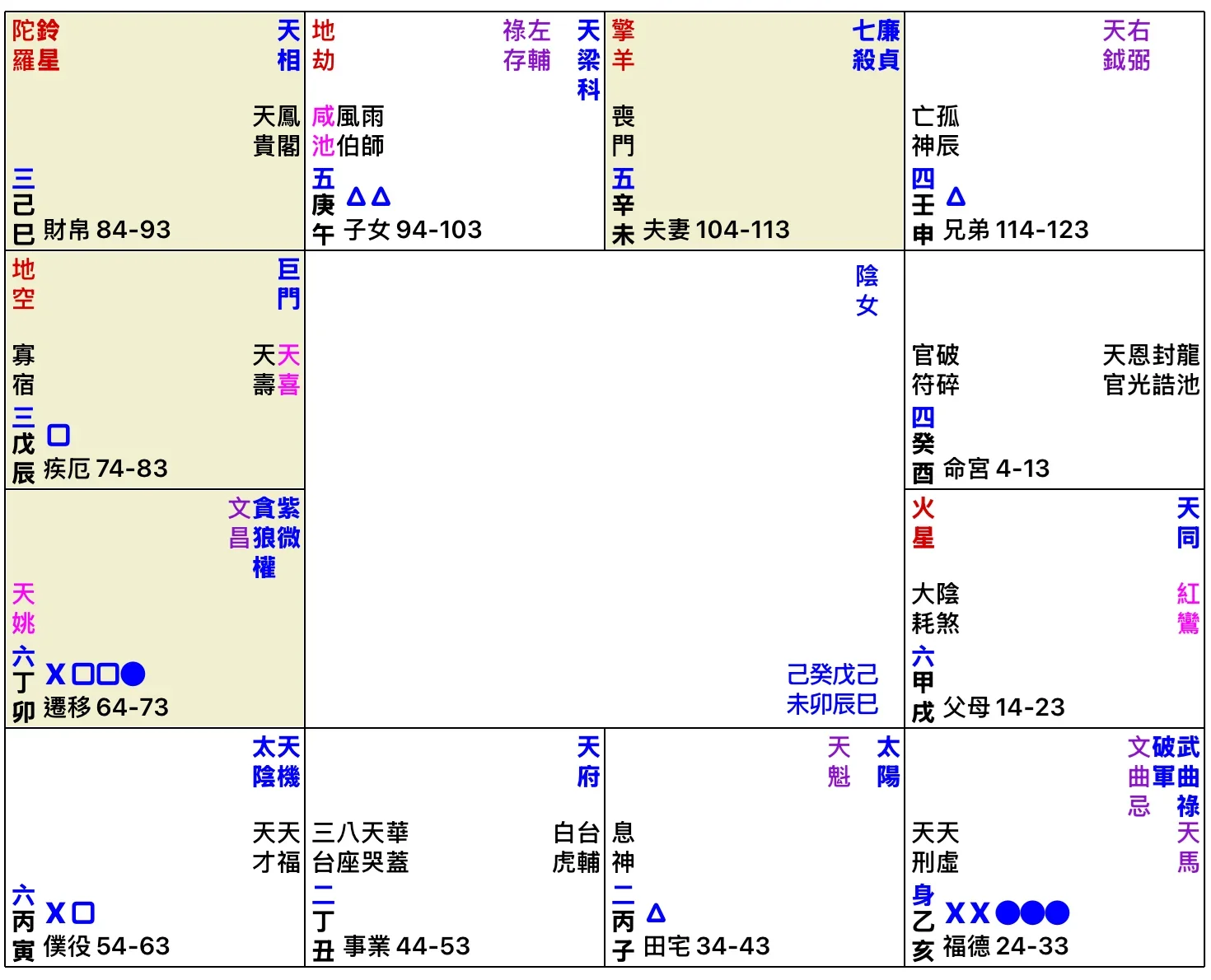
Again, there's not much to read in this chart, so let's transform it:
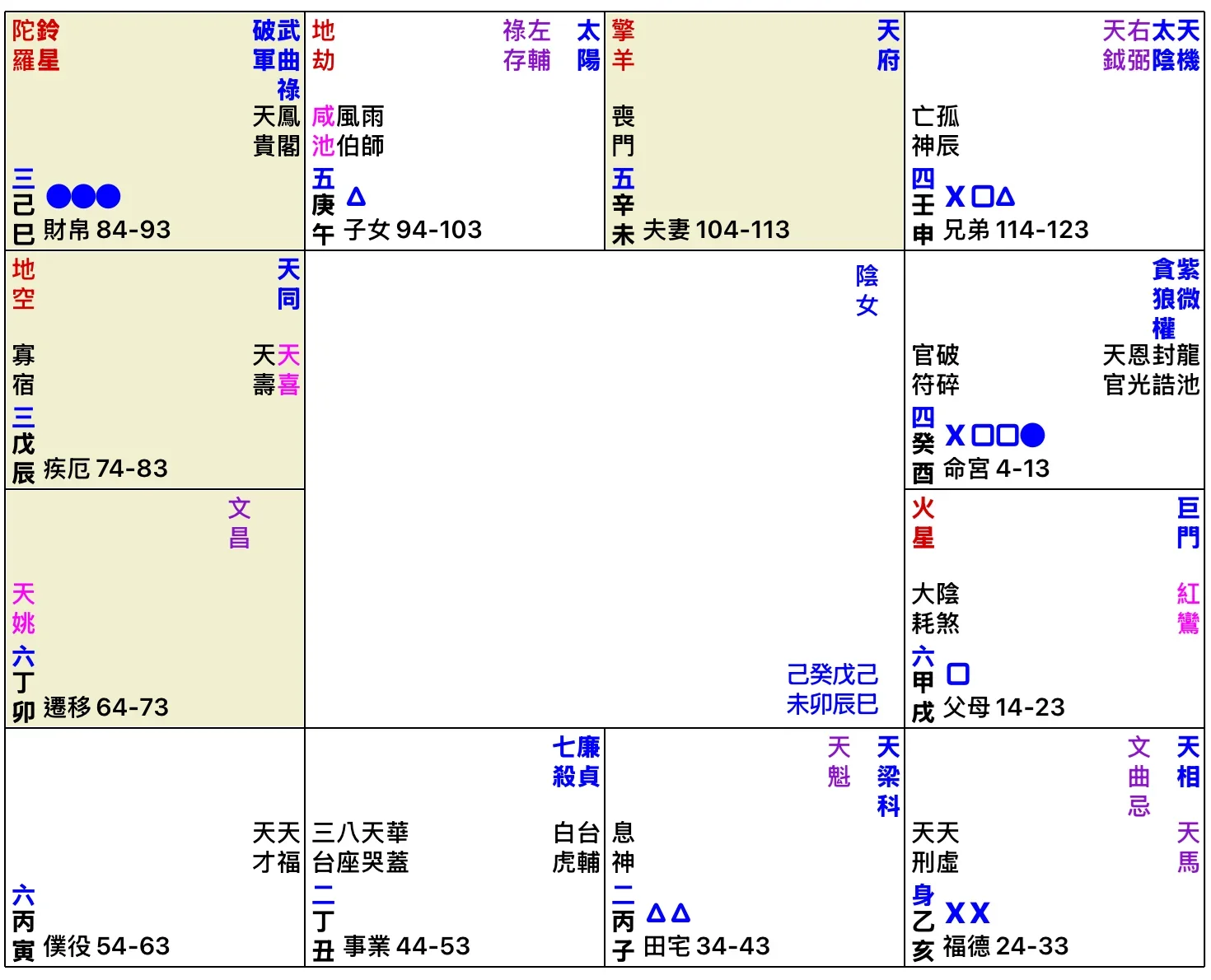
What signs in this chart point to opening a restaurant?
The 巳 Palace (with its three sides and four directions: 丑, 酉, 亥)
- 武曲 (Wu Qu) and 破軍 (Po Jun) in 巳: often doing hourly or freelance case work.
- 鈴星 (Ling Xing) and 陀羅 (Tuo Luo) in 巳: professional technical skill.
- 咸池 (Xian Chi) and 天喜 (Tian Xi) flank the 巳 Palace: a distinctive take on "beauty."
- 地空 (Di Kong) and 地劫 (Di Jie) flank the 巳 Palace: highly focused on running the business, strongly professional. If making products, she will focus on one or two, not make everything.
Overall: the subject tends toward hourly or freelance work, has professional skills, possibly related to "beauty." If in a "beauty" industry, a single product line but highly professional.
The 酉 Palace (with its three sides and four directions: 巳, 丑, 卯)
- Quan stars concentrated: starting a business.
- 紫微 (Zi Wei) and 貪狼 (Tan Lang): the double-star 殺破狼 (Sha Po Lang), a varied career, possibly starting a business selling her own products.
Overall: the subject's entrepreneurial pattern is strong; she should start a business selling her own products.
The main star 天相 (Tian Xiang) in 亥 (with its three sides and four directions: 未, 卯, 巳)
- 天相 in 亥 sees 2 Ji stars: their destructive force is small, and the 亥 Palace has no malefics.
- 3 Lu stars meet from the 巳 Palace: 天相 has no transformation of its own and is influenced by the 3 Lu; very likely she earns her income from "fine food."
- 天姚 (Tian Yao) meets from the 卯 Palace: in terms of "fine food," it will be high-end.
- 天相 sits with 文曲 (Wen Qu) and sees 文昌 (Wen Chang): a well-known, modern product; if it's food, it will have a filling inside.
Overall judgment: if the subject earns her income from fine food, it should be high-end, well-known, creative, with a filling.
- Me: People whose main star is 天相 have sensitive taste and are very likely to earn from clothing or food; with romance stars, they have an especially strong feel for "beauty." 武曲 and 破軍 with malefics suggest hourly or freelance work, but since Quan stars are also concentrated, if it's hourly, it's high-paid, or you're even your own boss.
- Subject: I did start my own business. The product is Western desserts.
- Me: You probably started it just in the last few years. 天相 is strong, so you can earn from clothing and food. 武曲 and 破軍 see romance stars, and 天相 sees romance stars too, so the desserts are probably high-end, with a fairly narrow product range.
- Subject: Yes.
- Me: 天相 also sees 昌曲, so the dessert probably has a classical character blended with modern creativity. It seems to have a filling.
- Subject: My desserts do have fillings, in many flavors. I've tried cilantro, cinnamon, pudding, taro, mochi, fruit milk, corn soup and so on, and customers have rated them well.
- Me: I'm curious which shop your desserts come from and which direction it faces. Can you tell me?
- Subject: Sure, the direction is 酉.
- Me: A shop facing 酉: big profits, very good business. I don't know if there are long lines, but the reviews are good, though occasionally you get bad reviews when you're too busy.
- Subject: Bad reviews are fine too. Isn't that a sign of good business?
- Me: I'll try your desserts when I get the chance. They must be delicious.
The subject is young and has started a successful business. Her Google Maps rating is as high as 4.9 stars, and when I googled the dessert's name, her shop appeared right on my first page, and not as an ad.
I wanted to say which dessert shop it is, but when I asked, the subject, though successful, is low-key by nature and didn't want me to publish her shop's details, so I can only discuss this chart of a high-end Western dessert seller in veiled terms.
Work has been busy lately, with new courses filling my calendar one after another, and writing teaching materials leaves my head spinning. I hope that once I finish the materials soon, I can update more often.
The next article will still be about restaurants!