I Want to Fly, But... I Can't
AI translated from the original Chinese.
Since I started writing about Dou Shu, I have kept wondering whether to write about some "special cases." I discussed it with some friends: some think special cases are worth reading and I might as well write them; others think they will scare readers away and I shouldn't write anything too lurid. I hesitated because I feared readers who can't interpret charts would compare my special cases with their own charts and misread them.
Since studying under Master Huang, I have attended nearly all his "Star Natures class" and "Live Chart class." My chart interpretation skills in particular came from the Live Chart class, where students bring cases and the teacher analyzes and explains them on the spot. Over the course of my studies I brought many cases, and my classmates' verdict was: "Anthony, why are your cases always so unusual?"... Um... how am I supposed to respond to that...
Perhaps it's because 天梁 (Tian Liang) is especially strong in my chart. I always run into special people and special events, so I have an unusually large number of special cases. I really don't know whether that's a good thing or a bad thing. 😂
Anyway, today let's write about a special case and see whether it scares readers.
In Zi Wei Dou Shu there is a famous pattern called "巨火擎羊, hanged for life." It means that if 巨門 (Ju Men), 火星 (Huo Xing) and 擎羊 (Qing Yang) appear together among the twelve palaces, the result is "hanged for life." Such verses frighten many Dou Shu beginners, because "hanged" refers to hanging oneself, and many fortune tellers interpret it directly as "death by hanging."
But in studying Dou Shu one must understand that the chance of forming a "negative pattern" is actually very high. Search anyone's chart and you will surely find many negative patterns. So why do some people's negative patterns take effect and others' don't? The reason is whether there is a "clash of Ji and malefics," that is, 化忌 concentrated and malefic stars concentrated at the same time. So the chance of a negative pattern taking effect is not as high as one might think.
Back to "巨火擎羊, hanged for life." Literally, "hanged" does mean death by hanging. But we should ask: why is "hanged" paired with "for life"? Because the pattern is not about death by hanging but about "being bound in a cocoon of one's own making." In other words, someone with the 巨火擎羊 pattern easily spends a lifetime trapped by themselves, as if life had them by the throat and they could barely breathe: a pattern of frustrated ambitions.
I bring up this pattern because it relates to the special case I want to discuss today. As the title says, let's look at today's case:
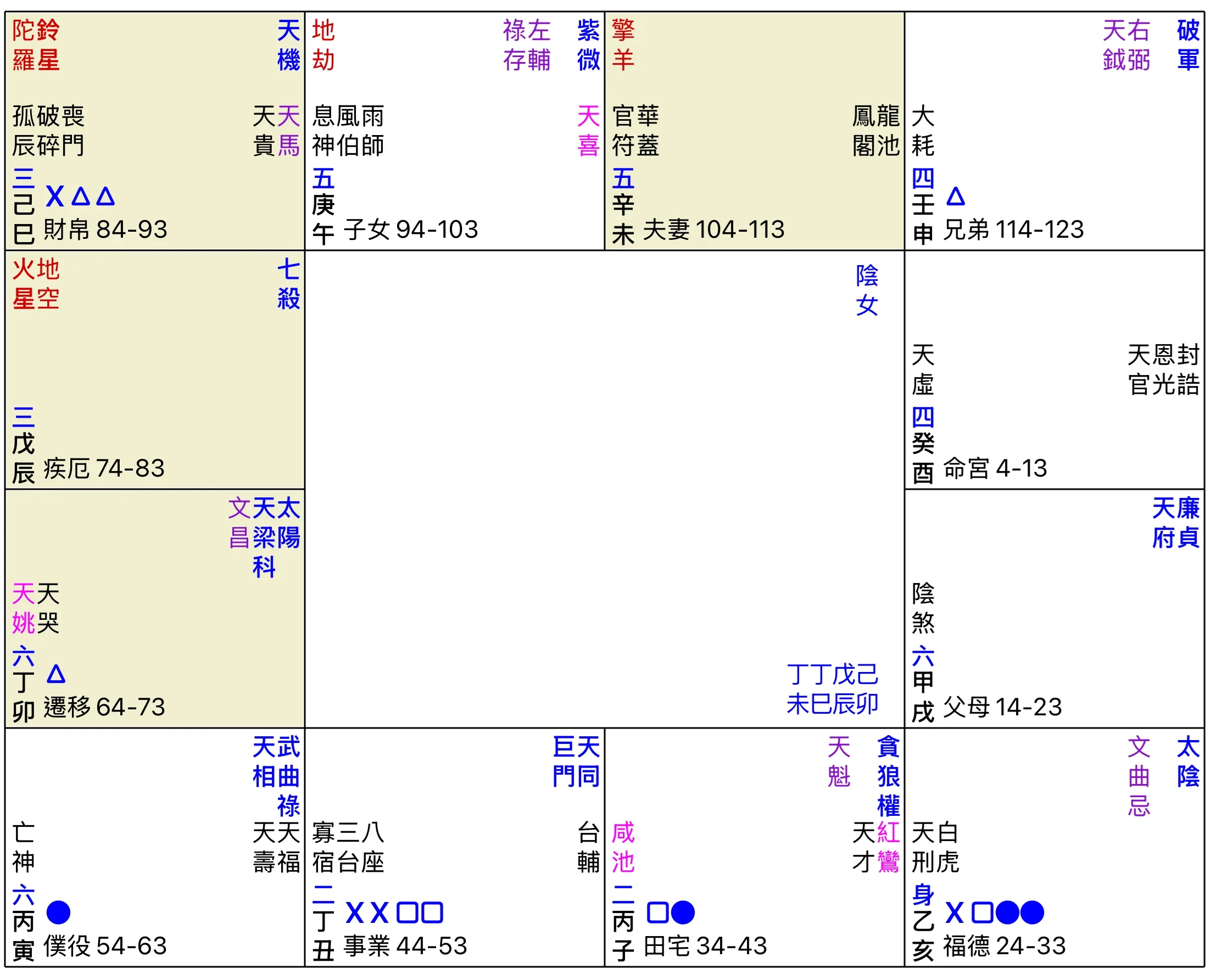
As usual, personal details are hidden; let's talk about what is special about this chart. Traditionally, the 命宮 (Life Palace) is empty and borrows 太陽 (Tai Yang) and 天梁 from the opposite palace, looking quite close to the "陽梁昌祿" scholar pattern. The three sides and four directions can indeed combine into 巨火擎羊, but not concentrated. Is it really so serious? Let's transform the chart a little:
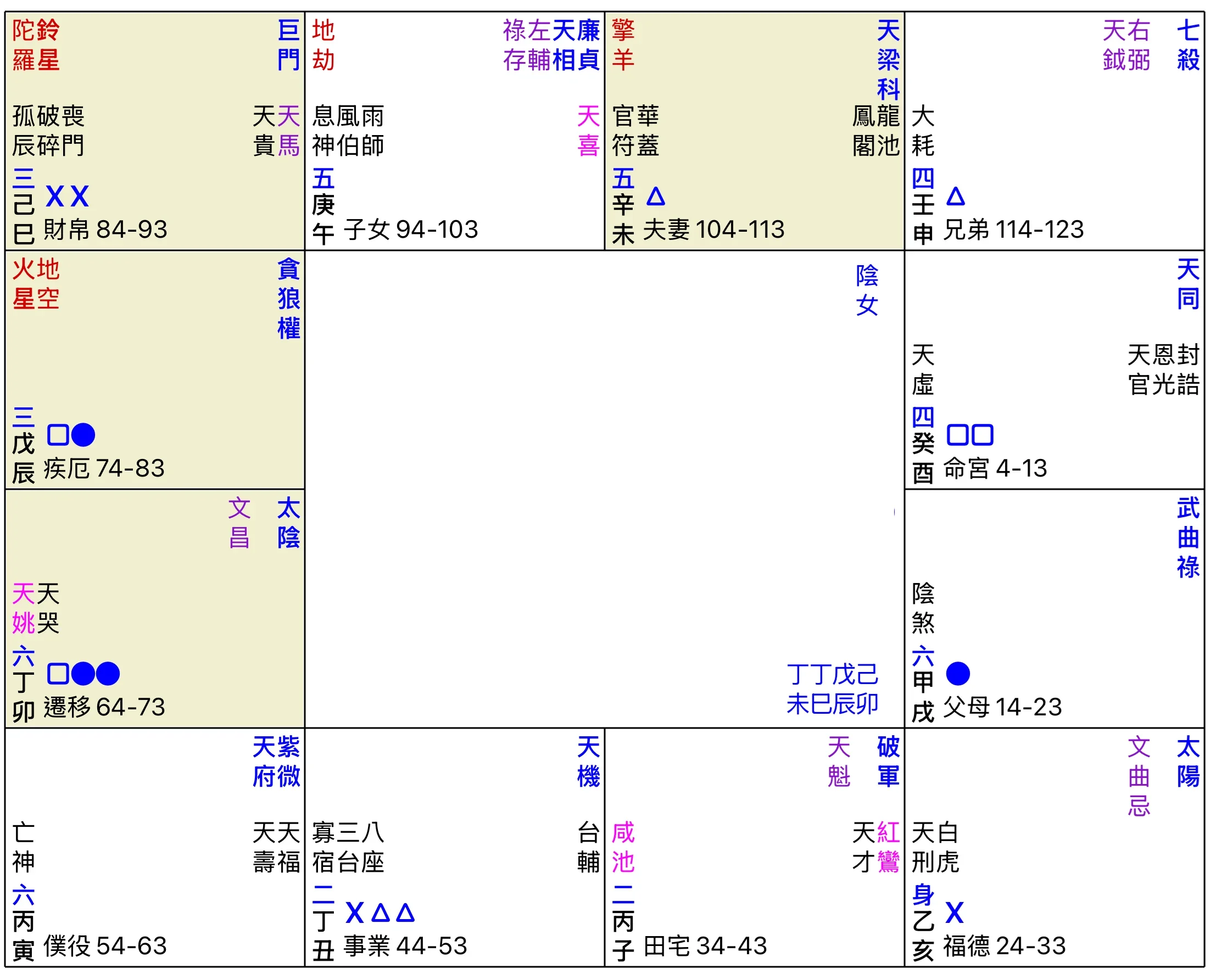
We lock our focus directly on the 巳 Palace.
The 巳 Palace (with its three sides and four directions: 丑, 酉, 亥)
- Four 化忌 concentrated in the three sides and four directions, giving 巨門 a negative effect. 巨門's nature is "darkness": a heavy heart, often with physical and mental problems.
- 巨門, 鈴星 (Ling Xing), 陀羅 (Tuo Luo): the effect is similar to 巨火羊, because 火星 and 鈴星, and 擎羊 and 陀羅, are paired stars, so the effect is also "hanged for life": feeling one's life tied up and one's ambitions frustrated.
- Stem 己: 文曲 (Wen Qu) becomes 化忌 in the 遷移宮 (Travel Palace) of 巳 (the 亥 Palace), meaning travel far from home is unfavorable.
- Flanked by 地空 (Di Kong) and 地劫 (Di Jie): chaos, so the mind cannot think calmly and steadily, and cannot take in anyone's advice at all.
Overall judgment: the effect in the 巳 Palace is that the subject has physical and mental problems, feels her life tied up and her ambitions frustrated, feels no one understands her, and wants to go abroad and leave the place that binds her, thinking she will find freedom and release that way. But if she actually goes abroad, things will get worse.
In fact, in Dou Shu, the stars governing mental health are 廉貞 (Lian Zhen) and 巨門. When these two stars are in trouble, there are often symptoms such as depression or bipolar disorder. But I must stress: a diagnosis must be left to a professional doctor. Never look at a chart and claim someone must have depression or bipolar disorder. Those who interpret charts must be careful with their words.
When I saw this chart, I couldn't help frowning:
- Me: Is this girl not in very good shape, physically and mentally?
- Answer: Yes. Her moods swing violently, she doesn't listen to anyone, and when things don't go her way she often threatens self-harm to get what she wants.
- Me: Then she has probably actually done such things?
- Answer: She has used self-harm as a threat, but she has never actually harmed herself.
- Me: Has she ever threatened to jump from a building?
- Answer: Yes. I was out at the time and the family called me home urgently, because she was standing on the rooftop where there was no railing, wanting to jump. I calmly talked her down for a long time before she walked back to safety.
- Me: If she wants to go abroad or move out, don't agree. Don't let her out of your sight.
- Answer: Why?
- Me: She thinks leaving will make her feel better, but in fact it will be worse, and at worst she might take her own life. Especially with 破碎 (Po Sui) and 喪門 (Sang Men) in the 巳 Palace and 白虎 (Bai Hu) in the 亥 Palace... be very careful.
Facing a chart like this, I often don't know how to begin. If it were the person herself, I couldn't say it outright and could only urge her to seek physical and mental treatment, because we must not plant this bad seed in her heart. If the chart belongs to a client's family member, I can only explain the situation, urge them to take her for professional assessment and treatment, and ask the family to believe there is room for things to turn around.
Interpreting a chart is truly hard, because so many parameters must be brought in to reach a result. But explaining a chart is even harder. I always tend to interpret toward the positive and avoid talking about bad things as much as possible. But my teacher once said: "When a client comes for a reading, you may leave out the good things, but you must cover the bad things, because what the client needs to know is how to prevent the bad things." He is right, but striking the balance is truly hard. In this case, "巨火擎羊, hanged for life": how do I explain it to the client while avoiding planting a bad seed in their heart? Letting the client know how bad things are now, while making them believe everything can get better, takes an art of measure. Since the client has already asked about this, and we can offer no practical help, at least we can offer advice and assistance through the chart.
Finally, let me stress once more: "Destiny is not fixed." A negative pattern doesn't mean an incident will necessarily happen. Many people are born at the same time, and not every one of them will experience the same thing. All we can do is, on the basis of the chart, offer a road that should be easier to walk, without infallible pronouncements and without absolute certainty. To clear a path people can walk through a wilderness: that, I think, is the meaning of a reading.