Reflections: Thoughts After Recent Consultations, Part 1
AI translated from the original Chinese.

Generated by Gemini
No case study today. I'd like to share some thoughts from giving readings recently.
Over the past few months I have met dozens of people one after another. I went from facing strangers timidly at first to developing some habits for discussing charts. In this not very long time I have often heard similar questions, which I'd like to answer here together. Beyond that, what I most want to discuss is how clients can approach a reading with the right mindset. Since I have many thoughts, I will publish them in several articles.
1. Why does a reading require a birth certificate and the place of birth?
Before a reading I always ask clients to obtain a birth certificate and tell me where they were born. Many people who want a consultation find this odd and wonder why I care so much about it.
Before I truly began studying Dou Shu, I attended Dou Shu courses from many schools. Perhaps because of my academic training in graduate school, none of them convinced me, mainly because they had no basis.
After seeing Master Huang's dedication to collecting and collating editions of Dou Shu texts (see this article), I knew I had found a true teacher. Master Huang showed me that Zi Wei Dou Shu is a subject that requires research, not one where you pick up some old book and, without any critical thought, declare it the true secret manual and teach and use it blindly.
Regarding the time of birth, Master 紫雲 (Zi Yun) and the teachers of his school spent a long time investigating it, and through verification in real readings it is quite credible. Below is my understanding of how the concepts for "determining the hour in Dou Shu" have evolved. There may be omissions or errors, and I ask readers' guidance and forgiveness.
※ The 子 hour has no "early 子" and "late 子"
The first issue in determining the birth hour is "early 子" versus "late 子." Some schools hold that people born in the 子 (Zi) hour are divided into "early 子" and "late 子." I won't go into an academic discussion here, just the conclusion: in Han Chinese tradition, entering the 子 hour means entering the next day; there has never been a distinction between "early 子" and "late 子." This is one reason I ask for the exact time of birth, not just the hour.
※ The boundary between hours
My teacher once said: "In Master 紫雲's experience, the last 15 minutes of an hour can often be calculated directly as the next hour, perhaps because at the boundary one receives the energy of the next hour." For example, the 寅 (Yin) hour runs from 3:00 to 5:00 a.m.; after 4:45 one may already receive the 卯 (Mao) hour. After many verifications it has indeed proved accurate, but why the cutoff is 15 minutes is probably a matter of reading experience, and theoretical support is still needed.
※ The Dou Shu calendar
In researching the classics, Master 紫雲 and the teachers of his school noticed problems with the calendar in Dou Shu. Through research they realized that the calendar Dou Shu refers to seems slightly different from the current farmer's almanac, and so they worked out the "Dou Shu calendar." This is also why, when people come to me for a reading, I ask for their Gregorian birthday. When some people see that the "lunar birthday" in their chart differs from their actual lunar birthday, that is the difference between the "Dou Shu calendar" and the "farmer's almanac."
※ True solar time
Research into how Dou Shu determines time keeps advancing. In one class my teacher brought up the concept of "true solar time": the earth is round and every place has a different longitude, so in fact the time differs slightly from place to place. For example, Taiwan is in the +8 time zone, but compared with China Standard Time it is actually 6 minutes ahead. Those 6 minutes may well change the hour, so true solar time must be worked out before reading the chart.
The concept of "true solar time" had already been raised on DestinyNet 命理網, and a capable person wrote a program to calculate "true solar time."
So for a period I used true solar time for readings. Since I was only discussing charts with family and friends at the time, the sample was too small to verify whether true solar time is entirely correct. But the readings back then mostly went quite smoothly.
※ The hour is an astronomical clock, not a wristwatch
In recent years, Mr. 張維鈞 (Chang Wei-chun), a fellow student of Master Huang, put forward the argument that "the hour is an astronomical clock, not a wristwatch." In the spirit of research, my teacher tried it in class and verified charts with it, finding that the article's claims had a basis and the verifications were accurate. So since I began giving readings, I have used this theory to discuss charts with clients. In discussion I find that reading cases with this theory gives greater accuracy and a firmer basis for what we discuss. It is the method I currently use.
※ Two verifications, both correct
"The hour is an astronomical clock, not a wristwatch" means, simply put, that the ancients had no concept of clocks and determined time by sunrise and sunset. So in summer, the daytime hours are longer than 2 hours and the nighttime hours shorter; in winter it is the reverse. Using today's convention that every hour is 2 hours long cannot explain how the ancients determined the hour without clocks.
I used this concept to verify charts over these eight months and wrote two articles about it: "A Chart with an Uncertain Birth Hour: How to Fix the Chart" and "Fixing the Chart Again: The Role of the Minor Stars."
※ "A Chart with an Uncertain Birth Hour: How to Fix the Chart"
In this article the subject was born at 14:48, but look at the figure below:
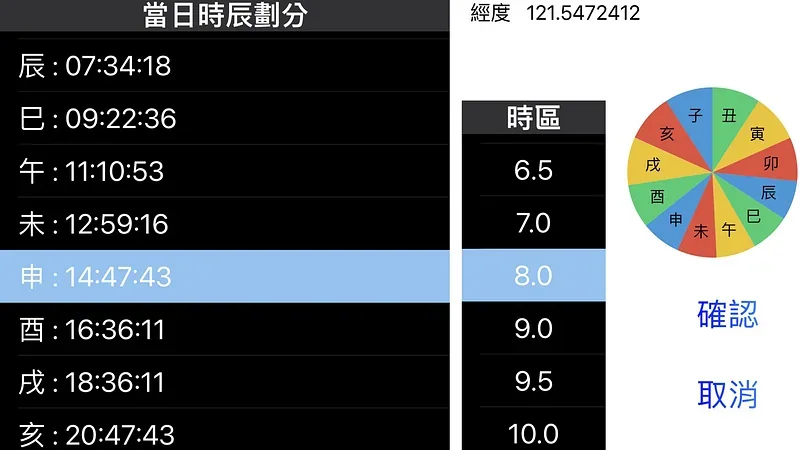
- 未 hour: begins 12:59:16, ends 14:47:43.
- 申 hour: begins 14:47:43, ends 16:36:11.
Normally the subject would be in the 申 hour, but just 17 seconds earlier would be the 未 hour, so I spent some space examining the correct hour based on the subject's real life, and concluded the 未 hour was right.
※ "Fixing the Chart Again: The Role of the Minor Stars"
In this article the subject first gave me a birth time of 4:17, then said she had misremembered and the correct time was 4:37. Either way, look at the figure below:
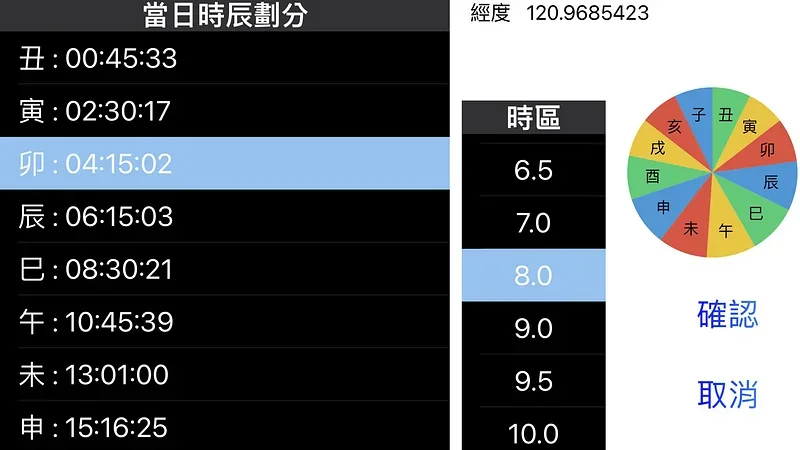
- 寅 hour: begins 2:30:17, ends 4:15:02
- 卯 hour: begins 4:15:02, ends 6:15:03
Because 4:17 is very close to the 寅 hour, I also spent some space discussing the correct hour.
- A 寅-hour person is not proactive about making money
- A 卯-hour person is very proactive about making money
After verification, the 卯-hour person matched the subject's character.
Yet the subject was born at 4:37, which traditionally would still be charted as the 寅 hour. But in reality, a 寅-hour person differs enormously from the subject's proactive attitude toward wealth. So I support the theory in "The hour is an astronomical clock, not a wristwatch."
※ Summary
I have tried to describe how the hour is determined in the most readable way possible. According to "The hour is an astronomical clock, not a wristwatch," summer daytime hours are often longer than 2 hours and nighttime hours shorter; in winter it is the reverse. After many verifications it is highly credible; at least so far it hasn't failed me.
Fate calculation is one of the divinatory arts and, traditionally, not considered respectable. Few people have ever subjected it to rigorous analysis and research. But Master 紫雲, my teacher Master Huang, and Master Huang's fellow teachers all approach Zi Wei Dou Shu with the attitude of academic research; only so can such an art make progress. And it is thanks to these predecessors' research that I have some small understanding of Zi Wei Dou Shu. In my self-introduction I say, "Twenty years wandering in Dou Shu, with no accomplishments." That is the truth: I only receive what my teacher teaches, with no original research of my own.
Think of it another way: if one just picks up 《十八飛星策天紫微斗數全集》 or 《紫微斗數全書》, declares it the one secret manual, never examines the calendar, never examines how the hour is determined, never examines the errors in the classics, and then gives readings on that basis, isn't that absurd? Even a divinatory art must be approached with a rigorous academic spirit. That is why I study under Master Huang and learn the theory handed down by Master 紫雲.
In sum: for a reading, the client must provide a confirmed time and place of birth; otherwise the reading won't work, and it's just a waste of time.
To be continued...